
<< back to the application gallery
OLED
2026-01-29 14:34:51

Preface

前言

Organic light-emitting diode (OLED) devices are widely used in high-end displays and solid-state lighting due to their self-emissive nature, wide viewing angle, high contrast ratio, and compatibility with flexible form factors. A typical OLED consists of multiple organic functional layers and electrodes, with a total thickness usually on the sub-micrometer scale. In such a multilayer optical environment, radiation generated by dipole emitters in the emissive layer is strongly influenced by optical confinement and interference effects. In addition, refractive index discontinuities between functional layers cause a large portion of the emitted light to be trapped inside the device in the form of waveguide modes or surface plasmon polariton modes, so that only a small fraction can escape into air. As a result, accurate modeling of multilayer optical behavior, combined with micro- and nanostructure design to enhance light extraction efficiency (LEE), is a key challenge in OLED optical design.

In this case, a 2D FDTD method is used to model an OLED device. By comparing structures without microstructures and with periodic microstructures (photonic crystals), the effect of microstructure design on LEE is evaluated.

OLED_structure

Simulation settings

Device introduction

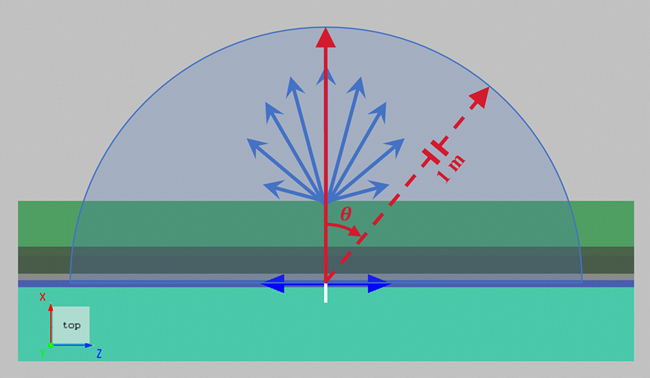
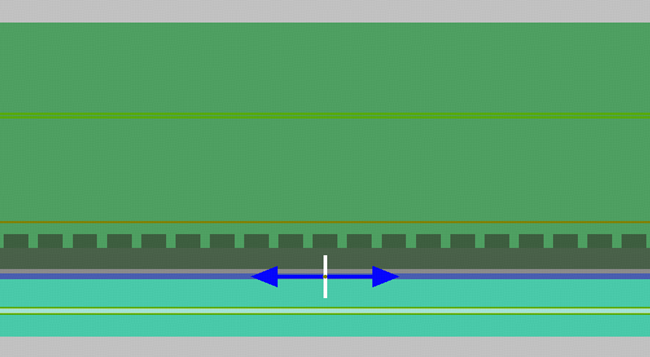
The simulation model is based on a typical planar OLED multilayer structure. From bottom to top, it consists of an aluminum (Al) cathode, a tris(8-hydroxyquinolinato)aluminum (Alq₃) organic layer, an a-NDP organic layer, an indium tin oxide (ITO) transparent anode, a silicon nitride (SiN) buffer layer, and a glass substrate. A periodically modulated silicon nitride photonic crystal (PC) structure is inserted between the SiN layer and the glass substrate to control light outcoupling and enhance LEE.

OLED_simulation

The emitting region is located in the Alq₃ organic layer and is modeled using electric dipole sources with wavelengths ranging from 0.40.4 to 0.7 μm0.7\ \mu m. These dipoles represent the optical behavior of spontaneous emission in OLED devices.

To model the radiation characteristics of a large number of incoherent emitters with approximately isotropic orientations in practical OLED devices, a statistical averaging approach is employed. Specifically, the spatial position and orientation of the electric dipole sources are varied within the emitting layer, and the radiation fields are calculated for different dipole configurations. The simulation results for different dipole orientations are then combined using weighted averaging to obtain an effective radiation response that represents the overall emission behavior of the device.

Simulation results

Radiation Characteristics and LEE

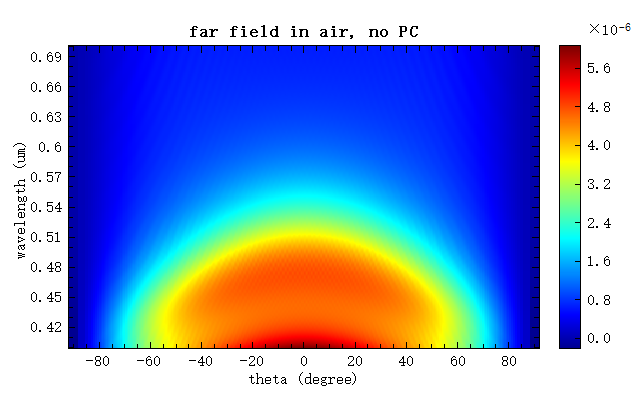
The attached OLED_no_pattern.msf script automatically adjusts the dipole orientation and runs the simulation to obtain results for the OLED structure without a PC. The Far field change index analysis group calculates the far-field angular distribution in air using a far-field projection method, as shown below. Refraction and reflection at the glass–air interface during far-field propagation are taken into account in this analysis.

OLED_noPC_farfield

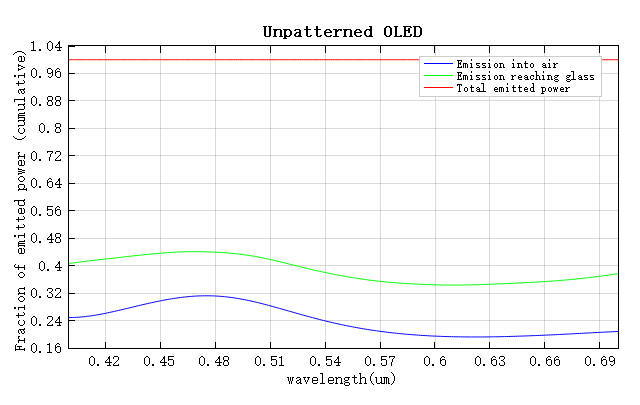
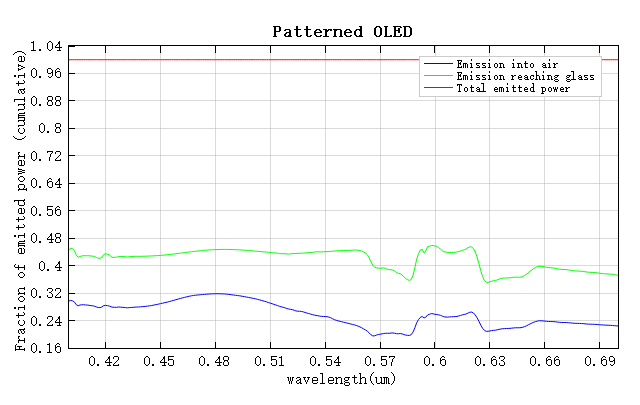
The corresponding power fractions are shown in the figure below. Here, “Total emitted power” represents the total radiation power generated by the dipole sources in the emitting layer. “Emission reaching glass” denotes the radiation power that propagates from the organic layers into the glass substrate. “Emission into air” corresponds to the radiation power that is ultimately coupled into air.

OLED_noPC_power

It can be observed that only a small fraction of the emitted radiation is eventually coupled into air. In particular, near the wavelength of approximately 0.6 μm0.6\ \mu m, the fraction of power entering air is below 20%20 \%. This indicates that radiation at this wavelength is strongly confined by optical modes inside the device, resulting in a limited light extraction process.

Effect of the PC on OLED Radiation Characteristics

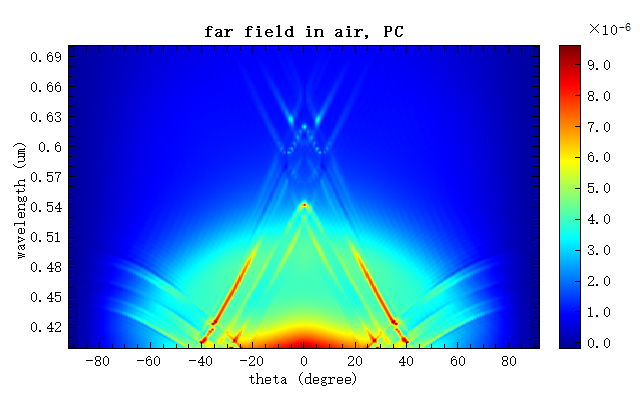
The attached OLED_pattern.msf script activates the PC structure in the project and adjusts the dipole position and orientation to obtain simulation results with the PC included. The far-field angular distribution in air is shown below. After introducing the PC, both the radiation pattern and its wavelength dependence change significantly.

OLED_PC_farfield

The corresponding power fractions are shown in the figure below. Compared with the structure without the PC, the radiation power distribution in air changes noticeably after introducing the periodic silicon nitride photonic crystal. In particular, near the wavelength of approximately 0.6 μm0.6\ \mu m, the fraction of radiation coupled into air increases significantly. This result indicates that the PC modifies the optical mode distribution inside the device and enables part of the radiation that is otherwise confined in the multilayer structure to couple more efficiently into free space, thereby improving the outcoupling performance in this wavelength range.

OLED_PC_power

Overall, the introduction of the PC structure effectively enhances light emission into air over specific wavelength ranges and provides a viable approach for further optimization of OLED light extraction efficiency.

Enhancement of LEE

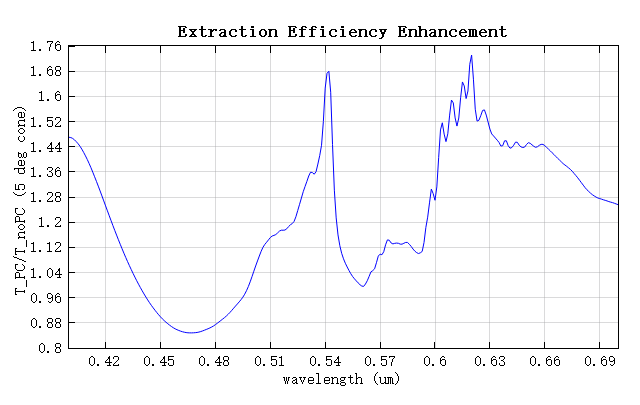
The enhancement of LEE is evaluated by comparing the extraction efficiencies of the structures with and without the photonic crystal, defined as:

LEEenhancement=LEEpatternLEEnopatternLEE_{enhancement}=\frac{LEE_{pattern}}{LEE_{nopattern}}

Based on the far-field distributions in air for both structures, the attached OLED_enhancement.msf script calculates the enhancement of light extraction efficiency within a 5-degree collection cone, as shown below. The results demonstrate that the photonic crystal structure can significantly improve the light extraction efficiency of the OLED over specific wavelength ranges.

OLED_LEE_enhancement

In this article
Top